Bitcoin (BTC) news

Santiment: Bitcoin FOMO fades after CLARITY Act failure and Fed hike, hashrate rising
Why it matters: Rising hashrate increases miners' costs and has historically coincided with price gains, but market sentiment remains subdued.

Coinbase shares rebound 4% after CLARITY Act failure and SEC tokenization exemption
Why it matters: Tokenized stocks could become a new growth source for Coinbase, but fee pressure and regulatory uncertainty remain risks.

BlackRock buys $1.08 billion in BTC over 20 days, IBIT holds 785,900 BTC
Why it matters: The concentration of BTC in IBIT strengthens BlackRock's influence on the market and pressures competitors like Grayscale to reconsider fees.
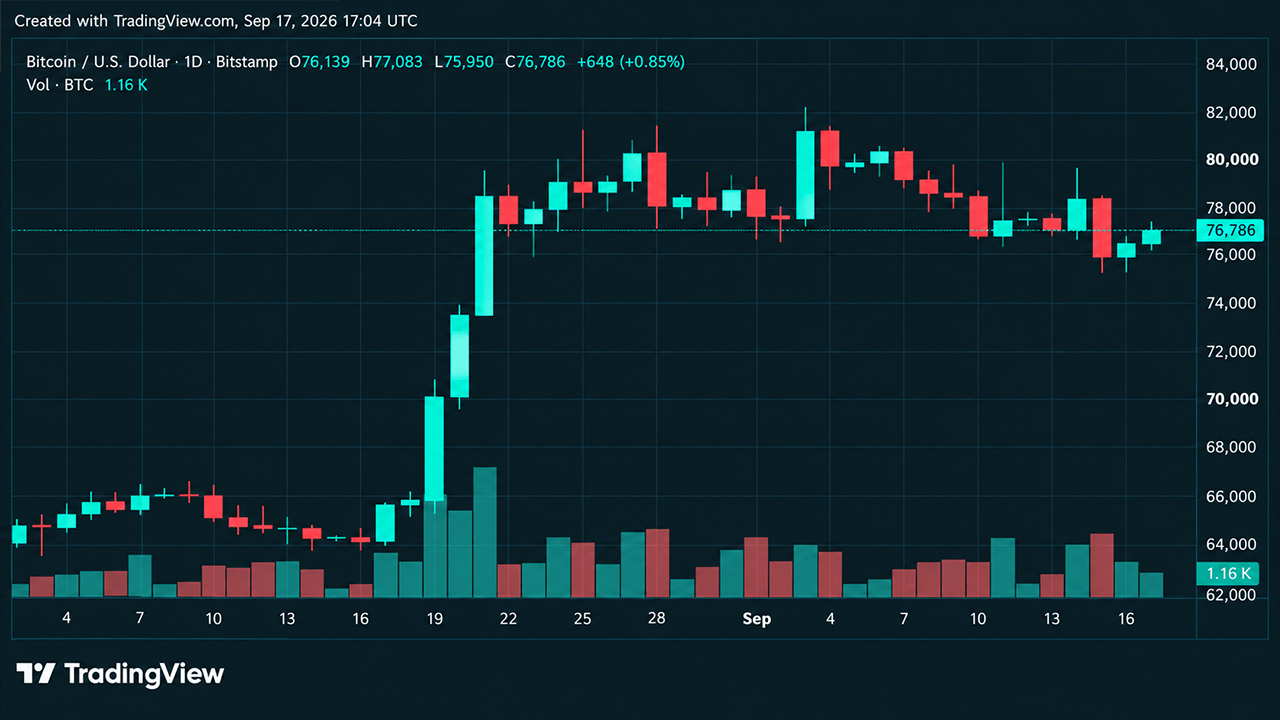
Bitcoin touches $77,000, short liquidations exceed $260 million
Why it matters: The rebound shows the market has digested the hawkish FOMC, but the failure of the CLARITY Act leaves DeFi in regulatory uncertainty.

Aptos rises 6.61% to $0.582 amid short liquidations and L1 rotation
Why it matters: APT's rise is a result of a market rebound after short liquidations rather than its own catalyst, so the sustainability of the move is questionable.

Bitcoin holds near $76,500 after Fed decision, $345 million liquidated
Why it matters: Bitcoin's resilience near $76,500 while stocks rebound shows the market is digesting a hawkish Fed without a new selloff.

Bitcoin rebounds as markets brace for the Fed's next move
Why it matters: Further Fed policy will determine the direction of bitcoin and the broader crypto market in the coming weeks.

RWA futures volume surges 142x after $19B liquidations
Why it matters: The growth of RWA derivatives shows demand shifting from crypto assets to contracts on commodities, equities and private companies after the largest futures crash.

Aave unveils Custodied Collateral Lending: stablecoin loans against assets held by custodian
Why it matters: Aave opens DeFi access to trillions of dollars in institutional assets, but increases reliance on a trusted custodian.

Bitcoin Bull Score crashes from 80 to 30 after Fed rate hike
Why it matters: The signal confirms a shift in sentiment: without the index returning above 60 and the price above $83,000, sustained gains are unlikely.

Saylor: banks will start bitcoin-backed lending without Congress
Why it matters: The signal of banks entering bitcoin-backed lending expands institutional demand and reduces the market's reliance on legislative initiatives.

Bloomberg analyst: bitcoin ETF assets to triple gold ETFs in 3-5 years
Why it matters: Faster bitcoin ETF adoption among younger investors strengthens institutional demand and competition with gold as a safe-haven asset.
Morgan Stanley tops 8,000 BTC for the first time via spot ETF MSBT
Why it matters: A major bank continues to build bitcoin exposure through its own ETF, supporting institutional demand.

Bitcoin Life launches regulated bitcoin life insurance bonds in Guernsey
Why it matters: The product gives long-term holders a regulated wrapper for estate planning and tax deferral, which could attract institutional capital into BTC.

Ned Davis Research forecasts bitcoin at $170,000 by 2030 and $230,000 by 2035
Why it matters: The long-term targets contrast with the $450 million outflow from spot BTC ETFs on September 15 and the price's proximity to mining costs.

XRP falls nearly 8%, Bitcoin drops to $75,800 after CLARITY Act fails in Senate
Why it matters: The CLARITY Act's failure hits altcoins and exchanges harder than BTC; a return above $78,189 would signal the removal of the regulatory premium.

Bitcoin rebounds to $76,628 after CLARITY Act fails; ETF outflows hit $1.11B
Why it matters: The divergence between rising prices and ETF outflows points to weak institutional demand; key BTC resistance sits at $77,296.

Bitfinex: bitcoin recovers to $76,500 after Fed rate hike
Why it matters: The $77,100 and $75,000 levels will determine bitcoin's direction in the coming days after the hawkish Fed decision.

Bitcoin ETFs see $328 million in daily outflows, $920 million for the week
Why it matters: Sustained ETF outflows signal weakening institutional demand and could amplify volatility in bitcoin and ether.
Pentagon runs classified bitcoin projects for 'strategic advantage'
Why it matters: The signal of U.S. military involvement in crypto reinforces the narrative of state interest in bitcoin.