Bitcoin price and crypto market news

Bitcoin gives up all gains after 'golden cross' ahead of CLARITY Act vote
Why it matters: The outcome of the CLARITY Act vote and the Fed's rate decision will set the market's direction for the coming days.

Ethereum falls 2.7% to $2,446 and tests $2,434 support
Why it matters: Holding the $2,434 support will determine whether ETH's recovery from June lows remains intact.

Bernstein sees bitcoin at $150,000 by December, prediction markets at $75,000
Why it matters: The divergence in forecasts shows market uncertainty and the difference between institutional and retail views on bitcoin.
Bitcoin falls below $76,000, down 3.28% on the day
Why it matters: The break below $76,000 support increases the risk of a further pullback to $71,000-75,000 amid Fed expectations and the CLARITY Act vote.

AKE jumps 65% with no confirmed catalyst as 99.8% of volume flagged as wash trading
Why it matters: The price rally is not backed by real demand: with wash trading dominating and a low free float, the risk of a sharp reversal lower is high.

Home mining turns unprofitable in France as Antminer S21 Pro loses €9 a day
Why it matters: High electricity prices in Europe are pushing home mining abroad, increasing hash rate concentration in regions with cheap energy.

Morgan Stanley bitcoin ETF tops $600 million five months after launch
Why it matters: Bank distribution of bitcoin ETFs expands the buyer base beyond retail and creates more durable spot demand.

XLM holds near $0.195 as CLARITY Act odds fade, Stellar TVL rises to $250 million
Why it matters: Without passage of the CLARITY Act, XLM has few catalysts to break resistance, making a pullback to $0.17–0.165 likely.

Whale opens 30x long on 248.56 BTC worth $18.96 million ahead of CLARITY Act vote
Why it matters: Large leveraged positions ahead of the CLARITY Act vote amplify BTC volatility and the risk of cascading liquidations.

Forbes 400: Six Anthropic co-founders become billionaires as crypto wealth slips
Why it matters: The ranking shows capital shifting from crypto to AI, while public crypto companies have become notably riskier for large fortunes.

CoinShares: Bitcoin miners' shift to AI is now irreversible
Why it matters: The hashrate outflow to AI reduces capacity supply for BTC mining and reshapes the industry, affecting network difficulty and miner economics.

Bitcoin miners slip into losses: cost of $75,500 versus price of $58,400
Why it matters: Margin pressure is accelerating miners' exit and the conversion of their sites into AI data centers, which could reduce network hashrate and BTC supply from miners.

Traders eye $75,000 liquidity sweep before $90,000 target
Why it matters: The outcome hinges on the Fed meeting on September 15-16 and the CLARITY Act vote: a break below $76,000 would increase pressure, while a return above $79,600 would signal a bullish scenario.

Solana drops below $100, down 1.24% in 24 hours
Why it matters: SOL is losing the psychological $100 level, which could add pressure on altcoins amid weak demand.

Crypto stocks fall at U.S. open: Circle -5.97%, Coinbase -5.52%
Why it matters: Crypto stocks are falling harder than the broader market ahead of the CLARITY Act vote and the Fed decision, reflecting heightened investor nervousness.

Bitfinex: $197M Ethereum ETF inflow is arbitrage, not new demand
Why it matters: ETH ETF inflows can be misleading: a significant portion is arbitrage, not real demand for the asset.

ETH exchange supply falls to 6.06M, an 11-year low, as BitMine nears 5% of issuance
Why it matters: The shrinking liquid supply makes ETH more sensitive to demand, but the outcome depends on the CLARITY Act vote and the Fed meeting.
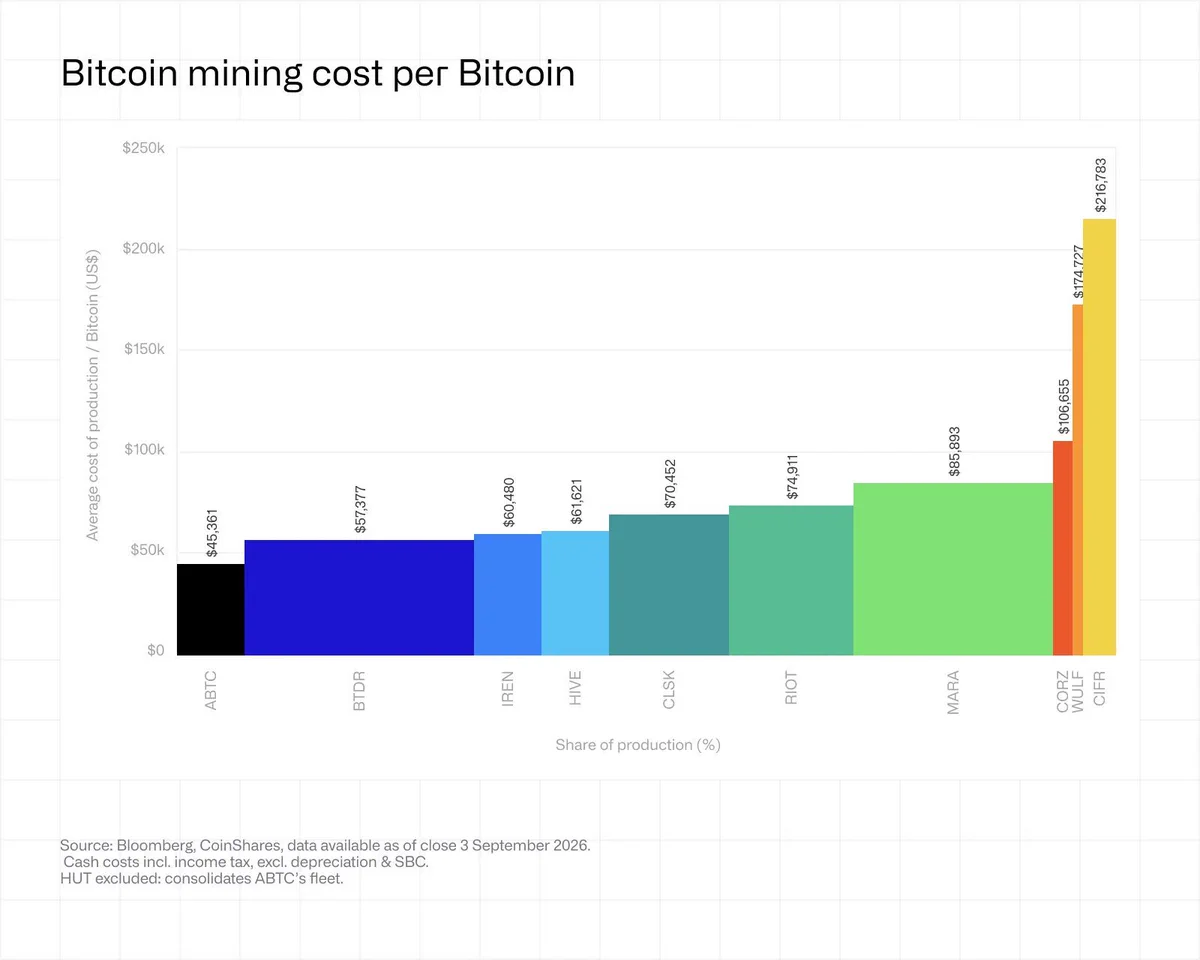
CoinShares: average cash cost of BTC mining rises to $75,500
Why it matters: Miners are operating below break-even, leading to capacity cuts and pressure on BTC supply.

XRP spikes to $1.41 then falls back into triangle as XRPL upgrade stalls one vote short
Why it matters: The XRPL upgrade delay and XRP's failed breakout weaken short-term momentum, while the outcome of the CLARITY Act vote will set the market's direction.

Solana holds near $100 as ETFs draw $11 million and network activity rises
Why it matters: Steady ETF inflows and rising network revenue support SOL demand, but a break toward $150 requires an exit from the triangle above $110.60.