Crypto news today

Ava Labs leadership change: Charlie Cooper becomes president
Why it matters: The personnel changes signal a focus on operational maturity and institutional growth for Avalanche, but do not affect AVAX's price in the short term.

CFTC seeks exclusive jurisdiction over prediction markets in New York court
Why it matters: The outcome of the dispute will determine whether states can regulate prediction markets, which is critical for Kalshi, Polymarket, and the entire US event-contracts industry.
House votes on strategic bitcoin reserve bill
Why it matters: Approval of the reserve could give bitcoin institutional legitimacy and new demand, while rejection would disappoint the market.
Bitwise CIO: US sacrificing crypto market safety for political points
Why it matters: The comment reflects growing industry dissatisfaction with political bargaining around U.S. crypto legislation.
USDT launched on Zama: confidential stablecoin volume tops $131M
Why it matters: Confidential stablecoins could attract institutional capital by hiding amounts and balances from the public blockchain.
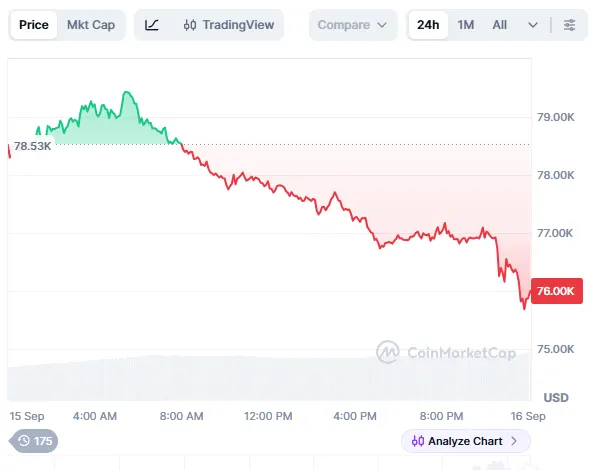
Crypto market declines: bitcoin $75,961, Ethereum $2,412
Why it matters: Rising derivatives volumes amid the decline point to increased speculative activity and the risk of further volatility.

ADA falls to $0.204 despite x402 integration on Cardano
Why it matters: Integrations without growing transaction demand do not save the price: ADA remains under pressure from macro factors and long squeezes.

Parity Technologies to move parachain functionality to JAM by 2027
Why it matters: The transition to JAM will determine Polkadot's future architecture and could affect developer and investor activity.

BIS: measuring economic activity on blockchain is harder than it seems
Why it matters: Differences in counting methodologies undermine trust in on-chain analytics that investors and regulators use to assess the market.

Coinbase shares rise 10% after Trump concessions on CLARITY Act
Why it matters: The bill would shift authority from the SEC to the CFTC and ease pressure on Coinbase, but falling odds of passage limit the stock's upside.
Bitcoin climbs back above $76,000
Why it matters: Reclaiming $76,000 keeps a key support level intact, which will determine the market's next direction.
Machi loses over $5M in a week, holds $47.98M ETH long
Why it matters: A large long with a nearby liquidation could add pressure on ETH if the price falls further.

Finam: 300,000 ruble limit will cut Russians off from crypto trading
Why it matters: The restriction effectively closes retail access to crypto in Russia and pushes demand into the gray zone and toward forged documents.

Trader turns $2,200 into $1.6M on PONS token
Why it matters: The case shows the speculative potential of tokens on Robinhood Chain, but the profit is not locked in and the risk of a price crash is high.

Bitcoin falls below $76,000, Ethereum loses $2,400 ahead of CLARITY Act vote
Why it matters: The market is pricing in the risk of the CLARITY Act failing: a weak vote could increase pressure on BTC and ETH.
Symbiosis bridge exploit: attacker mints 46.1 billion unbacked syBTC
Why it matters: It highlights cross-chain bridges' vulnerability to combined bugs and the risk of losing funds in syBTC liquidity pools.

Santiment and CryptoQuant: large wallets cut BTC, small ones buy
Why it matters: Mixed signals: short-term overheating risk amid accumulation by small holders, but reduced selling pressure could support a recovery above $80,000.
$101 million liquidated in an hour, 94% longs
Why it matters: Mass long closures point to a sharp price pullback and pressure on buyers.

Pyth Network launches six perpetual futures indices
Why it matters: It expands the toolkit for trading energy derivatives on Pyth's blockchain infrastructure.

US banks seek stablecoin yield limits ahead of CLARITY Act vote
Why it matters: The outcome of the dispute will determine whether stablecoins can compete with bank deposits and how the market will be structured after the CLARITY Act.