Crypto news today

Major banks expect a 25 bps Fed rate hike on Wednesday
Why it matters: A rate hike is largely priced in, but a surprise could trigger a new wave of liquidations in crypto.
Ripple expands college sports partnership with Louisville
Why it matters: Ripple's sports marketing spending does not directly affect the XRP price but strengthens brand recognition in the U.S.
Ethereum at $2,483: $74 million in liquidations and a test of $2,450 support
Why it matters: Holding $2,450–2,480 preserves the range and the chance of a test of $2,550; a breakdown would increase the risk of a deeper pullback.
Bitcoin falls to $76,000 as CLARITY Act odds drop to 11%
Why it matters: The CLARITY Act vote and the Fed meeting on September 15–16 are two binary events within a day that will determine the market's direction.

Silent Payments: mobile wallet scanning requires about 8 MB per day
Why it matters: Silent Payments could become practical on phones, but security depends on the completeness of the indexer's data, not just on traffic volume.

Circle launches cirBTC: transparent wrapped bitcoin for institutions
Why it matters: Transparent reserves and the absence of rehypothecation could accelerate institutional capital inflows into bitcoin-based DeFi.
KuCoin launches managed portfolios with a 100 USDT minimum
Why it matters: The exchange is expanding retail products, intensifying competition with Robinhood and Binance in the passive investing segment.
Forward Industries offers to buy SkyAI at a 50% premium
Why it matters: The deal would expand consolidation in the Solana treasury company segment; its outcome depends on shareholder and regulatory approvals.
Whale opens $54M BTC short ahead of CLARITY Act vote
Why it matters: The outcome of the CLARITY Act vote will determine BTC's direction: a break above $83,000 would confirm a bottom, while losing $75,000 would accelerate the decline.

Whale Alert: 688 BTC worth $52.6M moved from Coinbase to Binance
Why it matters: Large transfers between exchanges can signal a shift in sentiment and rising BTC volatility.

EU debates digital euro holding limit of €500–3,000
Why it matters: The digital euro is designed as a means of payment rather than an investment, and will compete with cards and euro stablecoins, not with bitcoin.

Ava Labs leadership change: Charlie Cooper becomes president
Why it matters: The personnel changes signal a focus on operational maturity and institutional growth for Avalanche, but do not affect AVAX's price in the short term.

CFTC seeks exclusive jurisdiction over prediction markets in New York court
Why it matters: The outcome of the dispute will determine whether states can regulate prediction markets, which is critical for Kalshi, Polymarket, and the entire US event-contracts industry.
House votes on strategic bitcoin reserve bill
Why it matters: Approval of the reserve could give bitcoin institutional legitimacy and new demand, while rejection would disappoint the market.
Bitwise CIO: US sacrificing crypto market safety for political points
Why it matters: The comment reflects growing industry dissatisfaction with political bargaining around U.S. crypto legislation.
USDT launched on Zama: confidential stablecoin volume tops $131M
Why it matters: Confidential stablecoins could attract institutional capital by hiding amounts and balances from the public blockchain.
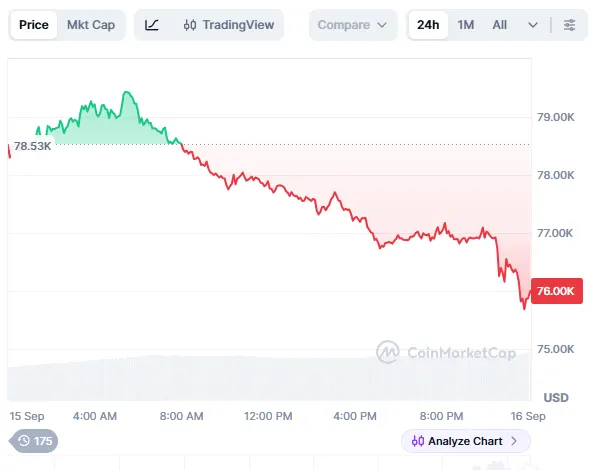
Crypto market declines: bitcoin $75,961, Ethereum $2,412
Why it matters: Rising derivatives volumes amid the decline point to increased speculative activity and the risk of further volatility.

ADA falls to $0.204 despite x402 integration on Cardano
Why it matters: Integrations without growing transaction demand do not save the price: ADA remains under pressure from macro factors and long squeezes.

Parity Technologies to move parachain functionality to JAM by 2027
Why it matters: The transition to JAM will determine Polkadot's future architecture and could affect developer and investor activity.

BIS: measuring economic activity on blockchain is harder than it seems
Why it matters: Differences in counting methodologies undermine trust in on-chain analytics that investors and regulators use to assess the market.