Bitcoin price and crypto market news

PONS rises 10% in 24 hours, market cap tops $650 million
Why it matters: The memecoin's rising market cap points to continued speculative demand in the small-token segment.

Block Scholes: Bitcoin and Ethereum IV around 38-39% and 52-54% ahead of FOMC
Why it matters: Low and flat IV ahead of the FOMC points to a lack of explicit hedging, raising the risk of a sharp move on a rate surprise.

Trader buys 3.25 million SYN on Aster DEX with 4x leverage, earns $304K
Why it matters: SYN's more than doubling drew in leveraged speculative capital, raising the risk of a sharp correction if the trend reverses.

Bitcoin at $76,440: whale positions and options strikes converge in narrow range
Why it matters: The convergence of whale, options and liquidation levels makes the $76,000-$77,750 range a zone of heightened volatility after the Fed decision.

Whale buys 5,368 ETH for $13 million at average price of $2,422
Why it matters: Large whale purchases can signal accumulation and support retail interest in ETH.
Analyst Lark Davis names bitcoin support levels at $73,000 and $67,000
Why it matters: The $73,000 and $67,000 levels are reference points for traders if BTC extends its decline amid tight Fed policy.

Bitcoin pinned between $71,300 and $79,800 by on-chain cost basis
Why it matters: Cost-basis levels define demand and supply zones: a break above $79,800 would open the way up, while losing $71,300 would intensify selling pressure.

Ethereum holds near $2,400 as BitMine approaches 5% of ETH supply
Why it matters: Corporate ETH accumulation and infrastructure upgrades support the price, but a break above $2,500 is needed for a reversal.

Zcash jumps 23% to $1,369 on Paradigm backing and network upgrade vote
Why it matters: Institutional backing and the network upgrade strengthen Zcash's position as the largest privacy coin amid a broader market recovery.
Trader closes ETH and SOL longs with $1.89M profit in 30 days
Why it matters: Large traders are again building BTC, ETH and SOL longs, which may signal a bet on continued upside.

$519M pulled from crypto ETFs in a day: BTC and ETH fall, SOL gains
Why it matters: A second wave of outflows from BTC and ETH ETFs signals weak institutional demand after the failure of the CLARITY Act and a hawkish FOMC.

Ethereum holds near $2,440 after Fed rate hike, range below $2,500
Why it matters: Holding $2,350 preserves the consolidation structure; a break above $2,500 would open the way to $2,600 and $3,000, while losing support would target $2,250.
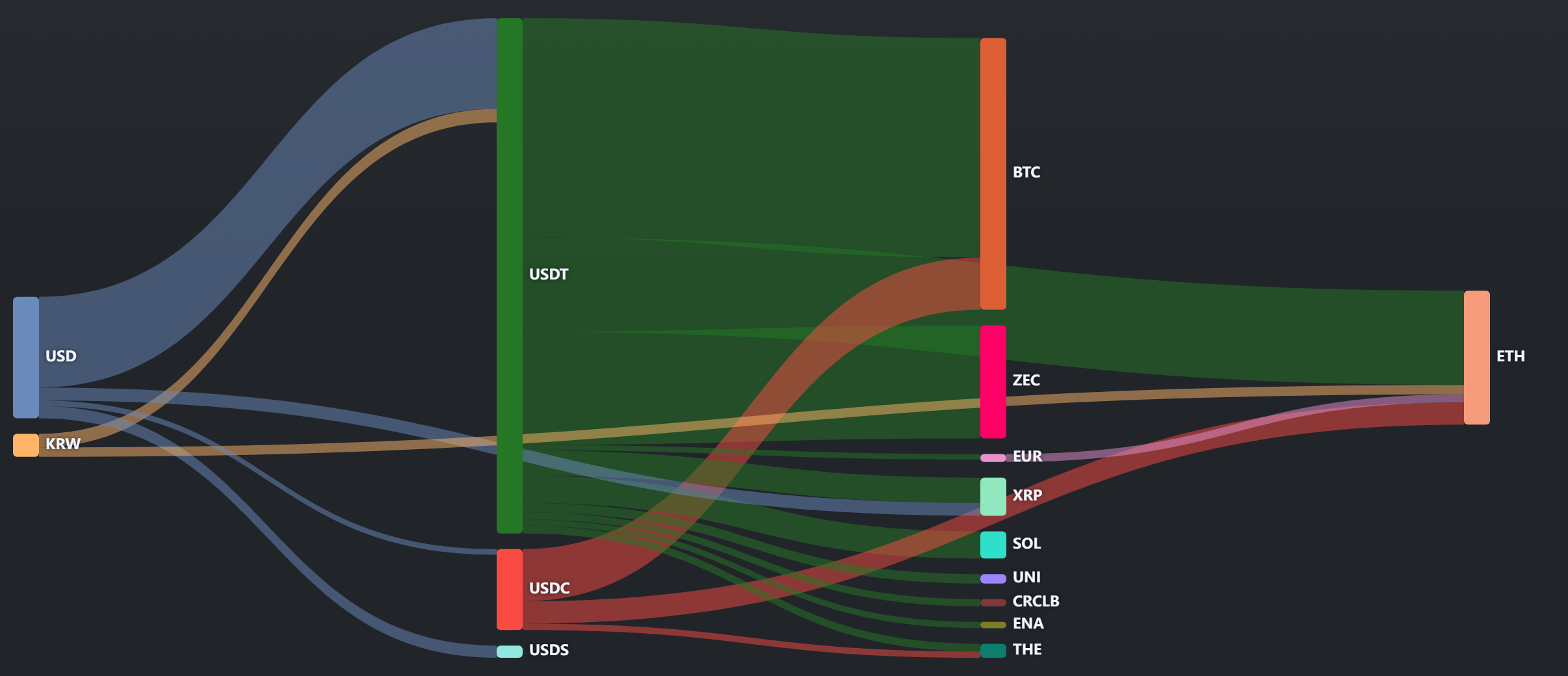
Crypto inflows hit $48.5M in 5 hours, with BTC leading and U second in outflows
Why it matters: Flow data shows where capital is moving within the market and which assets are losing support.

CORE jumps 8.98% in 5 minutes to $0.5245
Why it matters: The sharp move on extremely low volume makes it fragile: a break above $0.54 would extend gains, while losing $0.50 risks a pullback.

Analyst: bitcoin bear market may end in 20 days
Why it matters: The forecast relies only on time cycles without price confirmation, so traders should wait for market signals rather than dates.

PI falls 4.29%, now 96% below its all-time high
Why it matters: The token is in a sustained downtrend without a news catalyst, and rising volume on the decline confirms seller pressure.

POL rebounds 5.4% to $0.0968 on volume 67% above average
Why it matters: The rebound looks technical: without its own catalysts, Polygon depends on the macro backdrop and Fed decisions.

Meme coin MUSEBOOK jumps 260%, market cap reaches $16.76 million
Why it matters: The meme coin's rally around the AI platform MuseBook shows speculative demand for tokens tied to AI agents and tokenized stocks.

CRO rises 5.34% to $0.0587 on prediction markets launch in Cronos app
Why it matters: The rebound without volume confirmation may prove technical: CRO needs to reclaim its 200-day SMA at $0.0635 to change the trend.
CoinShares: Bitcoin miners fall below breakeven for the first time
Why it matters: Pressure on miner margins is accelerating their shift toward AI infrastructure, which could weaken Bitcoin hashrate growth.